
· 10 min read
Building a D-Day and WWII diorama with Sluban sets
A single tank on a shelf is a model; a tank next to a bunker, a landing craft and a group of soldiers is a scene. Sluban’s WWII range includes several sets that are designed as battle scenes rather than single vehicles, and a few of them fit together naturally around the D-Day landings. This guide shows which sets to combine, how to plan the space and how to make a diorama tell a clear story.
Start with one moment, not the whole war
The most common diorama mistake is trying to show everything at once. A strong scene shows one moment: troops leaving a landing craft under fire from a bunker, a paratrooper caught on a church tower, a patrol crossing a bridge in the snow. Pick the moment first, then choose sets that belong to it.
For D-Day, the natural moments are the beach landing and the airborne landings inland during the night before. Sluban has sets for both, so you can build them as two halves of one display.
The beach: bunker and landing craft
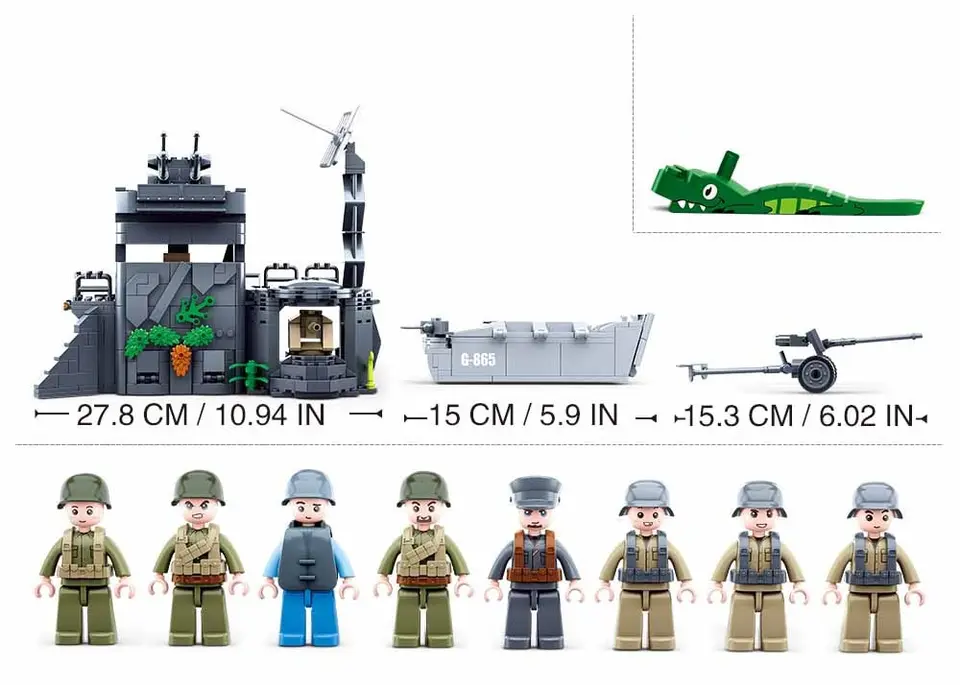
The WW2 Atlantic Wall D-Day Bunker (765 pieces) is the core of a beach scene. Its grey concrete bunker complex, about 27.8 cm wide, has a twin anti-aircraft gun on the roof, a machine gun nest, a casemate gun under an armoured dome and a radar antenna, and the set already includes a landing craft for the attackers.
Add the WWII Higgins Landing Craft (182 pieces) to make the landing feel bigger: its hinged bow ramp lowers for landing, and the set includes a black Czech hedgehog beach obstacle. The WWII US 4x4 Jeep with Field Gun (143 pieces) gives the troops something to bring ashore, and the WWII German 88mm Anti-Aircraft Gun (115 pieces) can sit behind the bunker as a second line of defence.


The airborne landings: church and transport plane
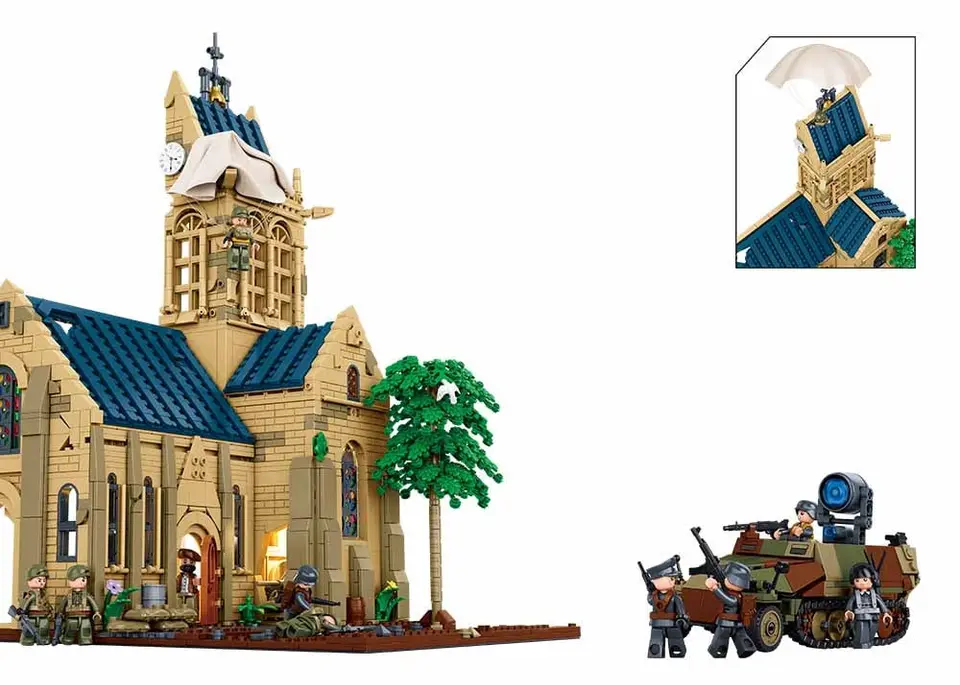
The Church in Sainte-Mère-Église (2,235 pieces) is the largest and most recognisable WWII diorama in the range. The tan stone church has a dark blue slate roof, stained-glass windows, buttresses and a clock tower, and a paratrooper minifigure hangs from the tower with his parachute caught on the roof – a scene that is famous from the night of 5–6 June 1944.
The C-47S (1,015 pieces, 1:44) is the perfect companion. It is olive drab with black and white invasion stripes on the wings, the stripes painted on Allied aircraft for D-Day. Hung above the church on a clear stand or displayed beside it, it shows where the paratroopers came from.


Other WWII battle scenes
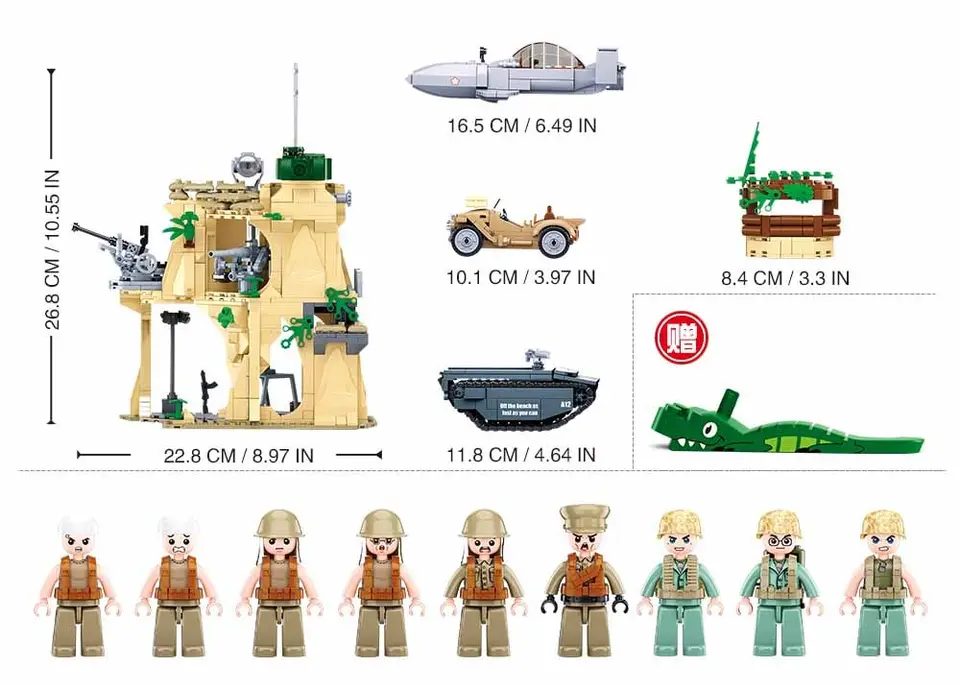
If you prefer another front, several sets are built as complete scenes. The WW2 Battle of Iwo Jima (1,124 pieces) has a tan rock bunker with a dug-in tank turret, an LVT amphibious tractor and other vehicles. The Battle of Kursk (998 pieces) contains eight separate builds from both sides, and the Battle of Stalingrad (479 pieces) combines a tank with a small city-battle setting.
For a winter scene, the Winter Battle Bridge Scene (769 pieces) has a green steel truss bridge on a stone pier and a snow-covered guardhouse, about 33.6 cm long together. At the smallest scale, the WWII Street View Hangar Diorama (142 pieces, 1:72) is a compact field hangar with tools, fuel drums and ammunition crates.


Adding people and small vehicles
A diorama comes alive when there are more figures than vehicles. The WWII Minifigure Blind Bag series has twelve soldiers from five nations, including a machine gunner on a tripod and a mortar team, and the WW2 Military Bundle (552 pieces) adds a fighter, a half-track, a truck with a searchlight, an armoured car and a field gun. The WWII German Amphibious Car (103 pieces) is a small detail vehicle that fits on a river bank or beach.



Planning the base and layout
Use large baseplates as the ground and decide where the ‘front line’ runs before placing anything. In a beach scene, water and sand should take up the front third, obstacles the middle and the bunker the back, so the viewer reads the attack from front to back. Leave gaps between groups so each part can be seen.
Height matters as much as width. Put tall elements such as the church tower, radar antennas or a plane on a stand at the back, and keep low vehicles in front. Even a few stacked bricks under the bunker make it look like it is on a dune.
- Pick one moment and one side’s point of view.
- Build the main set first, then place vehicles around it.
- Use more figures than vehicles for a lived-in scene.
- Keep tall builds at the back and low ones at the front.
- Leave space for a small card describing the scene.
For D-Day, start with the Atlantic Wall bunker and a Higgins boat for the beach, then add the Sainte-Mère-Église church and the C-47 for the airborne side. With a clear moment, a planned base and plenty of figures, a few Sluban sets become a real diorama.