
· 10 min read
Sluban warships: aircraft carriers, destroyers, submarines and sailing ships
Ships are the biggest models in the Sluban military catalogue, and they are also where scale matters most. A carrier and a destroyer only look right together if they share a scale, and Sluban has built several naval families at 1:350 and 1:450 that line up as complete fleets. This guide explains the scales, the main ship families and how to plan shelf space for models that can be over half a metre long.
Ship scales explained
Naval models use much smaller scales than tanks because real warships are huge. At 1:350, a 300-metre carrier becomes a model of about 85 cm; at 1:450 it is about 65 cm; at 1:700 it is roughly 40 cm. Sluban uses all three, plus larger scales such as 1:200 and 1:170 for historic sailing ships, which were much smaller than modern warships.
- 1:350 – the largest modern ship models: Liaoning carrier, cruiser, destroyer, submarine and the Bismarck.
- 1:450 – a complete modern fleet: two carriers, an amphibious assault ship, destroyer, frigate, submarine and supply ship.
- 1:700 – compact carrier models for small shelves.
- 1:200 and 1:170 – historic sailing warships.
The 1:450 modern fleet
The 1:450 family is the most complete naval group in the range. The Aircraft Carrier Fujian (1,312 pieces) has a flat flight deck with an angled landing area instead of a ski-jump, while the Aircraft Carrier (1,636 pieces) and the PLAN Liaoning Aircraft Carrier 1:450 (1,058 pieces) both have curved ski-jump bows. The Type 075 Amphibious Assault Ship (1,088 pieces) adds a long flat deck for helicopters.
Escorts complete the group: the Type 055 Destroyer (618 pieces) with its clean, angular superstructure, the Type 054A Frigate (417 pieces) with the number 54 on the bow, the Nuclear Submarine (269 pieces) and the Replenishment Supply Ship (497 pieces), which refuels and resupplies the fleet at sea. Lined up together, they form a realistic carrier group.
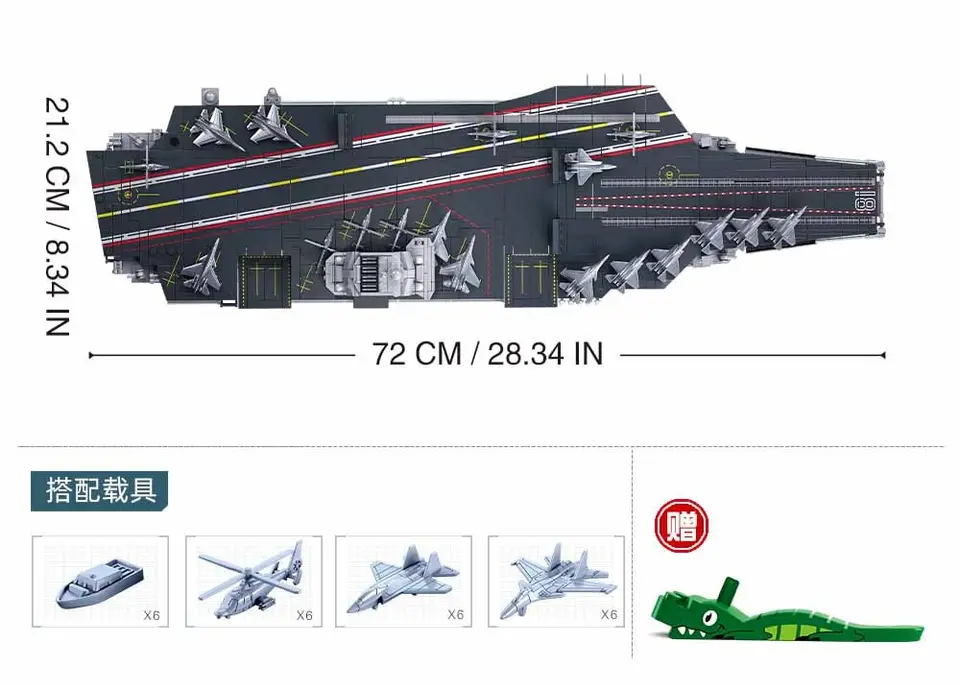
 Aircraft Carrier FujianM38-B1188 · 1312 pcs · 1:450
 Aircraft CarrierM38-B0698 · 1636 pcs · 1:450
 PLAN Liaoning Aircraft Carrier 1:450M38-B0399 · 1058 pcs · 1:450
 Type 075 Amphibious Assault ShipM38-B0699 · 1088 pcs · 1:450
 Type 055 DestroyerM38-B0700 · 618 pcs · 1:450
 Type 054A FrigateM38-B0702 · 417 pcs · 1:450
 Nuclear SubmarineM38-B0703 · 269 pcs · 1:450
 Replenishment Supply ShipM38-B0701 · 497 pcs
The 1:350 display ships
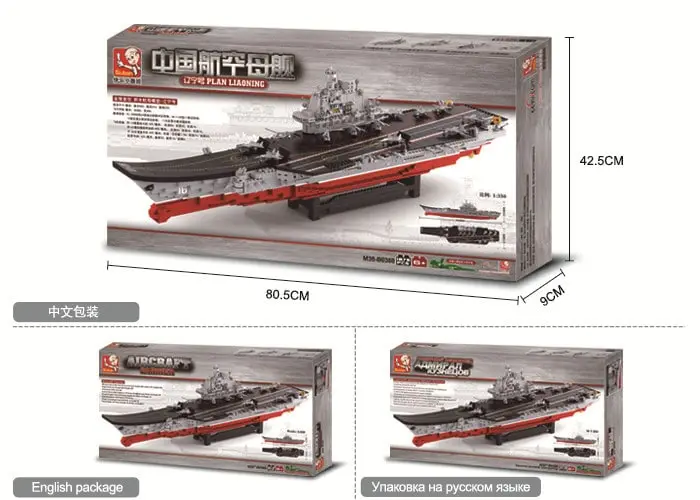
If you prefer fewer but larger ships, the 1:350 group is the one to choose. The PLAN Liaoning Aircraft Carrier (1,875 pieces) is the largest version of China’s first carrier with its ski-jump bow, and the Navy Cruiser (883 pieces), the Destroyer (615 pieces) and the Nuclear Submarine Display Model (193 pieces) all sit on black display stands.
The KMS Bismarck Battleship (1,849 pieces) is the historic highlight of the scale: a light grey hull with a red lower hull and dark angled camouflage stripes at the bow and stern. At the same scale as the modern ships, it shows how big a Second World War battleship was compared with a modern destroyer.


Historic sailing warships
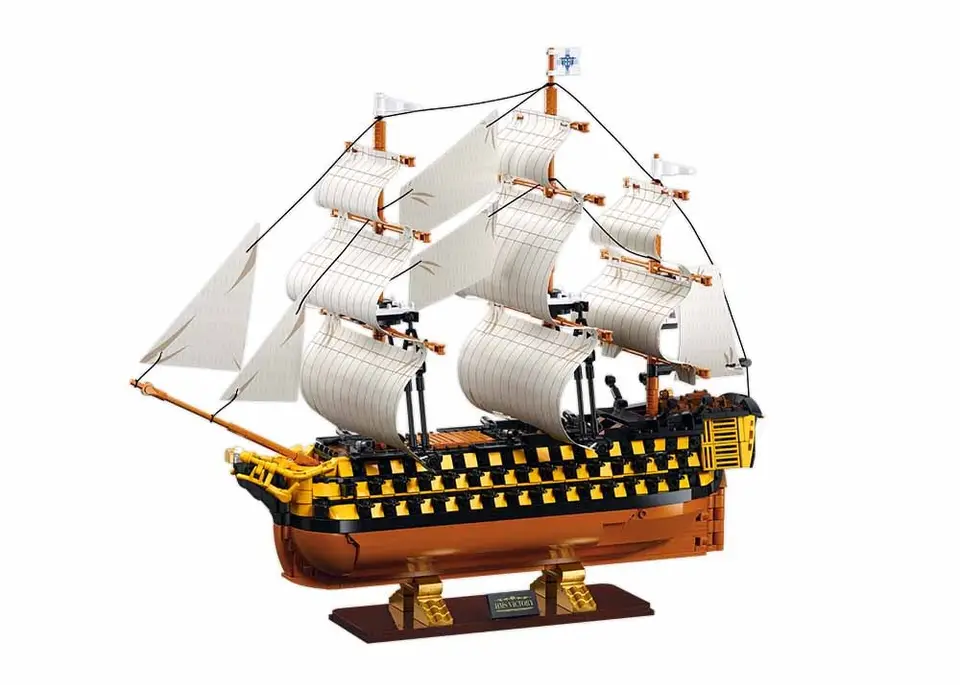
The sailing ships are a different kind of build: rigging, masts and rows of gun ports instead of radar and missiles. The HMS Victory Sailing Battleship (1,075 pieces, 1:200) has the famous yellow and black bands and gun ports along three decks. The USS Constitution (1,118 pieces, 1:170) is the American frigate with a black hull, a white band of gun ports and a dark red lower hull. They are among the most decorative models in the catalogue and look good on their own rather than in a fleet line.


Smaller naval sets
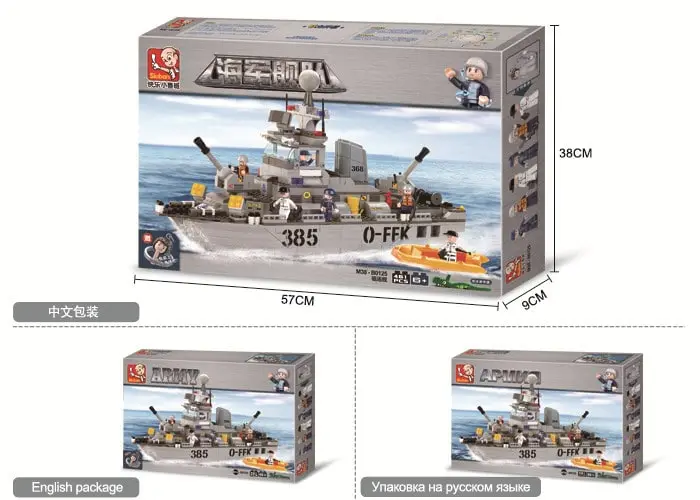
Not every ship needs to be a large display model. The Army line includes smaller play-oriented ships such as the Navy Destroyer 385 (461 pieces), the Cruiser (577 pieces) and the Coast Guard Frigate SL-288 (449 pieces). For a landing scene, the WW2 Battle of Iwo Jima set (1,124 pieces) combines landing craft and amphibious vehicles with a bunker.


Planning space for ships
Measure your shelf before buying a carrier. Long ships need deep, sturdy shelves, and they look best slightly angled so the viewer sees both the deck and the side of the hull. A row of ships should all face the same way, with the carrier in the middle and escorts in front and behind it, as they would sail.
Long hulls can flex during the build. Build on a flat table, press each hull section down firmly before adding the next, and only add masts, antennas and aircraft at the very end so they do not break while you handle the hull.
Choose a scale first – 1:450 for a complete fleet, 1:350 for fewer but bigger ships – and then add escorts around one carrier. For something different, a sailing warship like HMS Victory makes a standalone centrepiece.